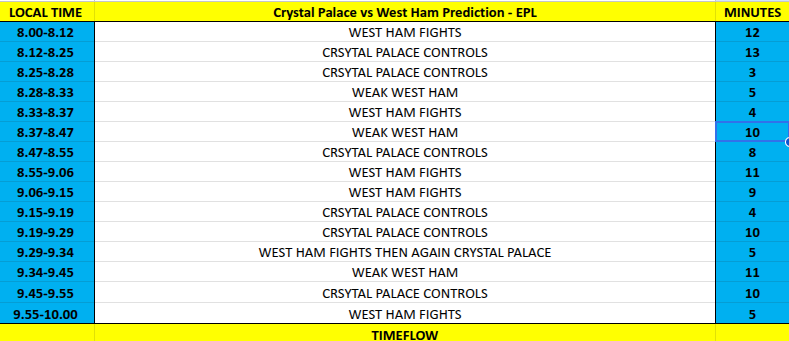
The match between Crystal Palace and West Ham United shows a mixed momentum pattern, where both teams get multiple control phases. This indicates a competitive game rather than one-sided dominance.
First Phase (8:00 – 8:25)
The match begins with West Ham showing early aggression, controlling the first 12 minutes. However, this is quickly balanced as Crystal Palace takes control for the next phase.
Insight: Fast start from West Ham, but not sustained.
Mid First Half (8:25 – 8:55)
Crystal Palace dominates multiple short phases, while West Ham appears weak in between. There are small interruptions where West Ham tries to fight back but fails to maintain pressure.
Insight: Crystal Palace builds early rhythm and looks more stable.
Late First Half (8:55 – 9:19)
Momentum shifts again. West Ham regains energy and pushes forward with back-to-back “fighting” phases. However, Crystal Palace still manages to interrupt and regain control briefly.
Insight: End of first half becomes more balanced and aggressive from both sides.
Second Half Start (9:19 – 9:45)
Crystal Palace gets a stronger hold again, controlling key phases. West Ham struggles in between, showing signs of weakness but still manages occasional fightback moments.
Insight: Crystal Palace slightly ahead in control phases here.
Final Phase (9:45 – 10:00)
The closing stage shows alternating momentum:
- Crystal Palace controls briefly
- West Ham responds with fighting energy
Insight: Match ends with high uncertainty and pressure from both teams.
Overall Match Pattern
- Crystal Palace Controls: More frequent but shorter bursts
- West Ham Fights: Strong aggressive phases but inconsistent
- Weak Phases (West Ham): Appear multiple times, indicating instability
- Momentum Nature: Back-and-forth, no clear domination
Final Prediction Insight
This match is likely to:
- Stay competitive throughout
- Have multiple momentum shifts
- Feature both teams creating chances in phases
- Be influenced by timing of key moments rather than full dominance